Licensing
What's free, what's licensed, and why the terms hold.
The specifications are free forever. The enforcement hardware is licensed under published FRAND terms. And the whole regime is held by an independent Foundation no single owner, including Triodian, controls.
The map
Three lanes: what's open, what's licensed, and how you'd extend it.
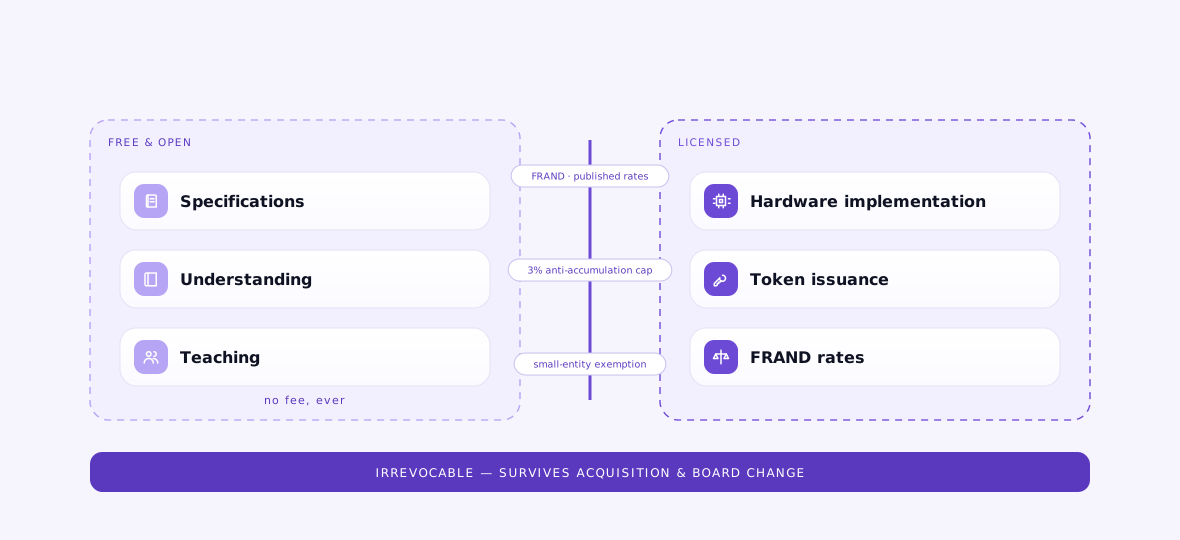
UGP specifications, conformance suites and SDKs · the Metamodel (CC BY-SA 4.0) · the content-provenance open dedication, C2PA / Content Credentials, CAWG, open consent registries, irrevocably royalty-free.
Understanding, teaching and studying never require a licence.
Explore the open protocol →The DGA claim set under FRAND. Software conformance is free; the cryptographic attestation regulators and procurement accept comes only from licensed hardware. The compliance token is the boundary object.
DGA Patent & SEP Licensing →The on-device / self-hosted claim family, where model, tools and actuators share a chassis, see On-Device Licensing. And the PACE methodology licence, see PACE Authoring.
The regime in five commitments
Headline level, the detail lives in the SEP page.
Published rates
Identical across the pool.
Anti-accumulation ceiling
On aggregate exposure, royalty stacking structurally impossible.
Small-entity exemption
Thresholds in the prospectus.
Annual transparency mandate
Agreements, allocations and distributions published yearly.
The open dedication
Content-provenance, irrevocable and royalty-free.
Why the terms hold
The IP will be custodied by the independent Casuarina Foundation, a charity being established with ACNC registration underway. The anti-acquisition provision, never exclusively transferable to a single private entity, is stated as the licensee's protection.
"The party that would benefit from tightening the terms does not control them."
How we're structured →How to engage
Three steps.
Request the prospectus
Evaluation licence
Pool admission
Existing product-tier customers are pre-qualified. A deployment contract and a licence are different instruments, the prospectus says which questions belong to which.
The honest boundary
A licence conveys rights to the claim set, not validation status. Mode A capabilities inherit the validation gate regardless of who holds a licence, and no licence constitutes a compliance endorsement of a licensee's product. Conformance questions belong to the UGP test suites; assurance questions to the product tier.
The transparency mandate is Rule 3 applied to the licensor itself, terms verifiable by parties who do not need our account of them to be true. The eight rules →
Three layers of rights
What an insurance partner would be licensing.
The protocol is open, the hardware is FRAND, and only a third, separate layer, insurance commercialisation, can be competitively allocated. Because that layer is not a patent licence, exclusivity can attach there and nowhere else without ever colliding with the FRAND commitment.
Any exclusivity is narrow, time-limited, and conditional on agreed validation, product-development and market commitments; the same structure that gives a partner counterparty durability keeps every position narrow. Arm licenses cores · Bluetooth certifies radios · HDMI licenses content protection, open spec drives adoption; a proprietary component anchors trust and value.
Commercial logic for discussion, to be confirmed with IP counsel against the Master Licence Agreement and Foundation deed.