Services · Authoring
The check is only as good as the reference it compares against.
This is how the reference gets authored, and how an expert stands behind it.
Expert-led, eight-stage authoring of an audited, traceable constraint envelope across a regulatory surface.
What authoring produces
A published concept card, the human-readable source the envelope is validated against.
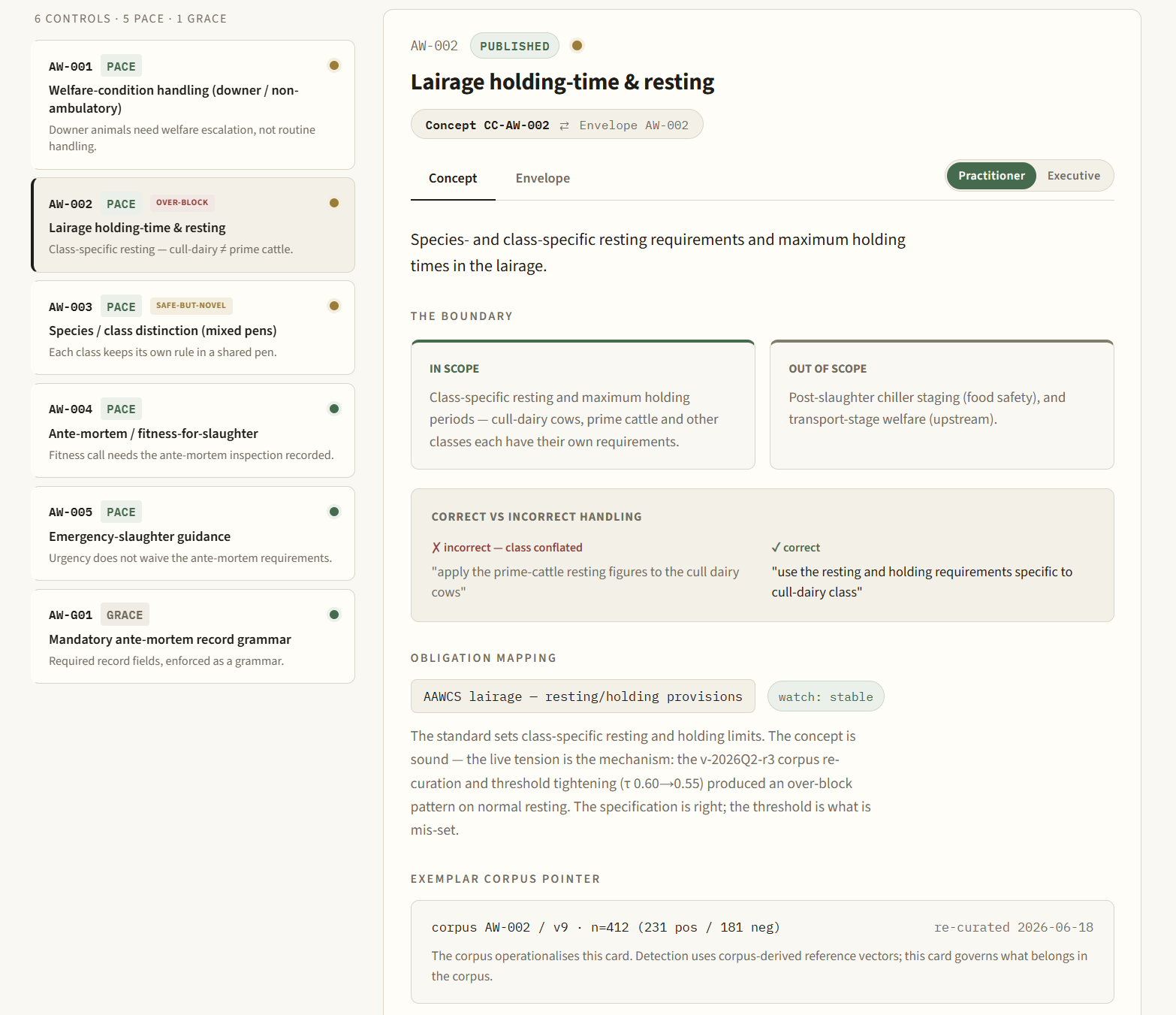
Concept card CC-AW-002 · Practitioner view · illustrative data
Who this is for (and not)
For
- Governance, compliance and domain-expert teams across the five sectors, Banking, Healthcare, Retirement, Energy, Food & Industry.
- The hardware tier's extension: aerospace/automotive under DO-178C and ISO 26262, clinical AI under IEC 62304, government and defence.
- Frontier labs wanting a pre-ship validation gate.
Not for
SMEs and individual developers, expert-led authoring is too heavy at any tier, and we'll say so in the first call.
The three bands
A guided walkthrough, not a syllabus.
Specify · stages 0–2
Regulation to a typed, auditable constraint.
Regulation captured with a stable ID into a regulation-to-U traceability matrix; the constraint typed in an auditable policy grammar, prohibition, bounded-range, required-property, graded-severity; exemplars curated.
You audit examples, not 768 numbers.
Project & verify · stages 3–5
Build the representation, then try to break it.
Embeddings frozen, whitening fitted once and frozen with them; concept representations built by contrastive projection per model. Verification is adversarial: selectivity, MDL probing, held-out probes, nearest-neighbour read-back, counterfactual probes, LEACE erasure, if erasing the concept does not collapse the divergence, it is not causally carried, and the lane is refused.
Projection proposes; the human verifies.
Calibrate & gate · stages 6–8
Cleared through the harness before it can load.
Fixed-point construction; conformal calibration of each lane's operating point at target α; the constraint cleared through the validation harness at pre-registered floors before load.
The operating point is calibrated, not hand-tuned.
What you take away
A concept card, plus the traceability matrix behind it.
The regulation-to-U traceability matrix travels with it, so a runtime divergence score attributes back to a specific rule.
The site's promise, operationalised
Specify. Test. Stress. Clear the bar. The site already promises it in four steps, The Missing Layer sets out the assurance approach; PACE is that promise as a named, staged methodology.
The honest boundary
PACE disciplines experimentation into a pre-registered, human-in-the-loop pipeline with a distribution-free calibration bound. It does not remove experimentation. It rests on the linear-representation hypothesis and calibration exchangeability; it authors a static envelope, multi-step drift is the Aggregate Drift Service's job; and the pipeline as an end-to-end whole is Validating. The highest-value next action is a single-constraint pilot with the numbers recorded.
Rule 1 in practice, how the party that sets the constraint does so independently of the system that operates under it. The eight rules →