The governance landscape
Every layer of AI governance already exists, except the one that makes the rest enforceable.
Principles, internal governance, vendor guardrails and standards all describe how AI should behave. Not one of them can prove, at the moment of action, that it did. That single missing layer, verifiable enforcement, is a smaller, more supportable proposition than “regulate AI,” and it is the whole of what Triodian builds.
The layers we already have
Four layers describe the rules. None stands where they are enforced.
Self-regulation, standards, internal governance and sovereign regulation are real, load-bearing layers, and you are right to rely on them. Each writes or assigns the rules well. What none of them does is stand at the point of action and enforce them.
one enforces them.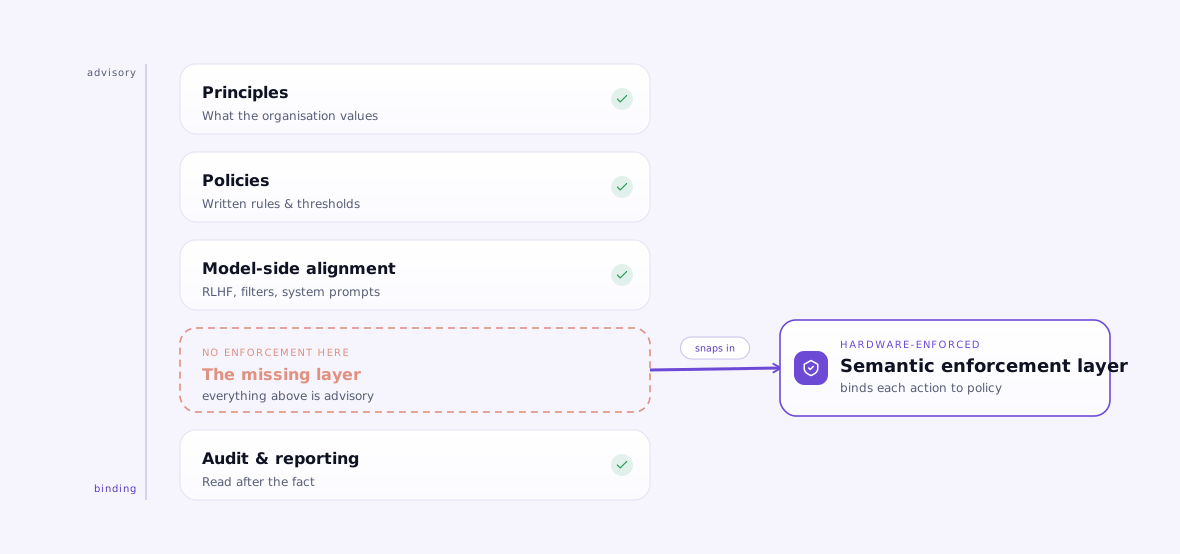
Government
Principles
States what AI ought to respect.
Business
Internal governance
Sets policy inside the organisation.
AI vendors
Guardrails
Steers the model from inside the model.
Standards bodies
Standards
Codifies what good looks like.
Triodian · the missing layer
Verifiable enforcement, at the moment of action.
The inversion
Who holds the power to enforce
Today the rule-maker and the rule-taker are the same company. Triodian moves enforcement to the sovereigns and organisations the AI actually answers to.
Self-regulation
Frontier labs write, test and police their own AI, rule-maker and rule-taker collapsed into one company. The only assurance that a model stayed within bounds comes from the party that built it and benefits from it being believed.
Sovereign & organisational governance
Enforcement moves to the sovereigns and organisations the AI answers to. Their mandates and policy become enforced, auditable behaviour on any frontier model, the rule-maker and the rule-taker are no longer the same party.
Now governed, on any model
Why this is a more fundable bet
Not a bigger problem, a smaller, sharper one.
Triodian is not trying to replace regulation, standards or model alignment. It provides the single missing enforcement-and-proof layer that sits beneath all of them. That makes the wedge narrower, the IP defensible, and the buyer already waiting.
A smaller surface area
We don’t rewrite the EU AI Act, APRA or ISO. We add the one enforcement layer that makes the rest checkable, far less to build, defend and prove than “govern all of AI.”
A clearer wedge
One job, done where no one else operates: verifiable enforcement at the point of actuation. It is a position that compounds rather than sprawls.
Defensible IP
The approach is the subject of a broad patent pending for the Deterministic Governance Architecture, set within a wider patent family.
A buyer already blocked
Regulated institutions are stalled at procurement by governance objections software can’t answer. We hand them the answer, demand that already exists, waiting for proof.
Where it sits
Adjacent to categories you know, identical to none.
Investors map a new company onto the categories they already understand. Each of these does real work. None of them can enforce a declared constraint at the moment an AI acts, and prove it held.

Our assurance approach
Tested before it’s trusted
We don’t ask anyone to take the enforcement on faith. Every constraint is validated against what it is meant to do, measured, stressed and reviewed against a defined bar, before it is allowed to govern anything live. It is a disciplined, evidence-led process - built so that, as the technology matures, the assurance we describe can be demonstrated rather than taken on trust.
Specify what the constraint must do, and what would count as failing it.
Test it against that standard under controlled conditions.
Stress it against edge cases and adversarial pressure.
Only put it into service once it clears the bar.